
Call of Duty: Modern Warfare 4
faye
Four banks, five vaults, one battery. A guide for players who want the cash and not the death screen.
Most loot in an extraction mode is a lottery ticket. A bank vault is closer to a job with a payout attached. Inside a vault you get cash, a guaranteed safe to crack, and a pile of other high-value items — and unlike most things on the map, the reward is roughly the same every time you finish the job.
Cash matters more here than in a normal shooter because of what it buys after the raid. The Vendor sells weapons and gear between missions, and those purchases decide how strong your next deployment starts. Cash is effectively the only currency that survives the extraction. Spend three minutes dying in a firefight and you leave with nothing; spend three minutes opening a vault and you leave with a loadout upgrade.
The mental model
A bank run is not a loot run, it is a supply chain: bank → cash → Vendor → stronger next raid → easier bank. Once you see the loop, the route stops being arbitrary.
One honest caveat before the routes: this is a multi-step objective, not a puzzle box you can sprint past. It has a preparation phase, a lock phase, and an escape phase, and each of them can kill you. That is the point. The design is asking whether you can plan a route through a hostile map, not whether you can click a prompt faster than someone else.
There are four banks around Hajin, and every one of them uses a locked vault as the prize. Three are small branch offices. The fourth sits inside the highest-threat zone on the map, and it plays by different rules entirely.
The three branches are compact interiors: a lobby, a few back rooms, a stairwell, a power box, and one secured door. You can clear them fast, and their vaults use the identical procedure. The Grid bank is a different animal — it is an extreme-threat area inside a tower, so you are not just opening a door, you are fighting your way to it and fighting your way back out.
Where to start if you have never done this
Begin with the eastern-most branch, north of Songdo Wharf. It is the least contested, and it has something no other branch has: three gas stations nearby, which matters enormously once you understand what the battery does to your odds.
Everything else in the bank is scenery. Three objects decide whether the vault opens:
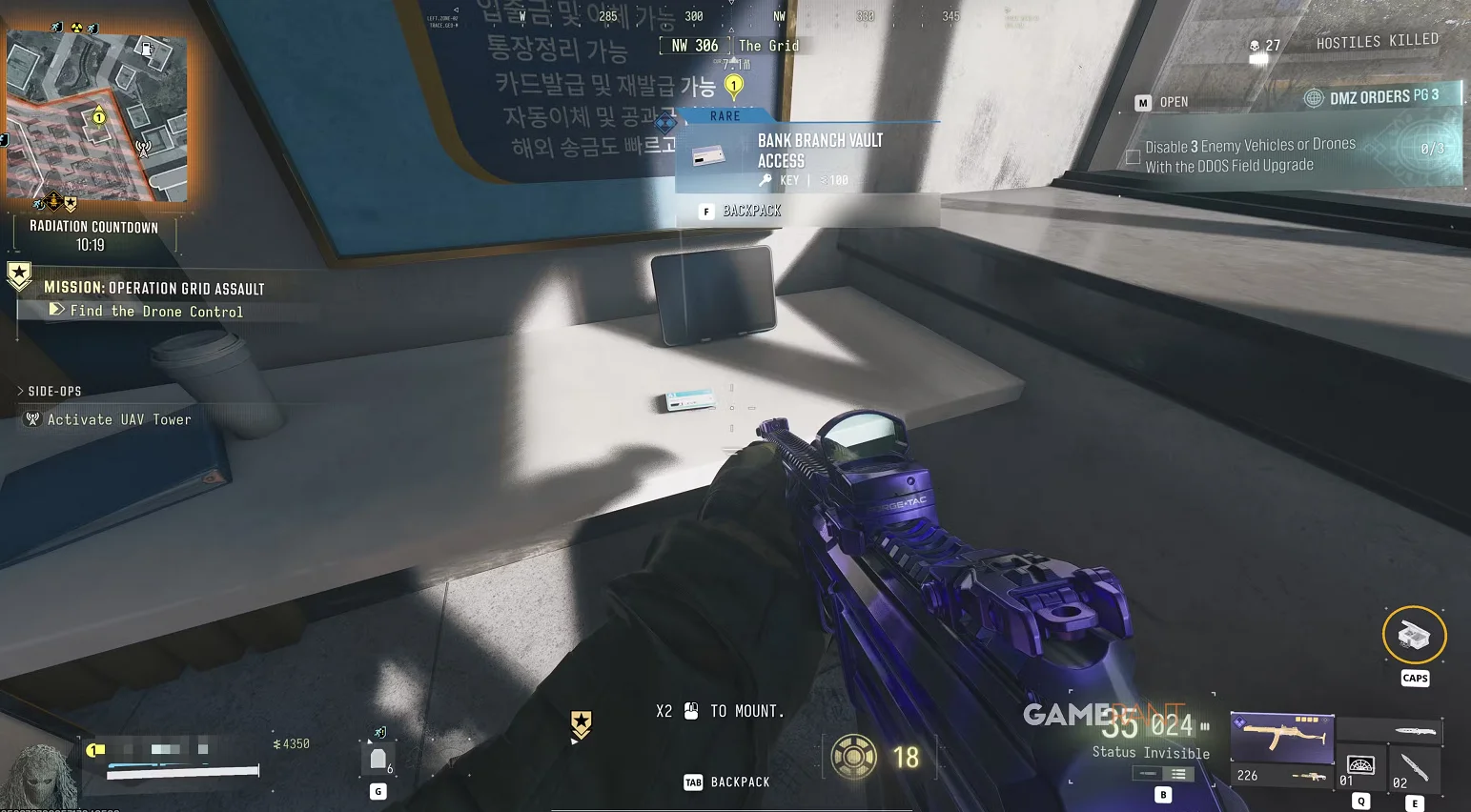
1. Branch Bank Vault Access Key
A keycard, and it is always somewhere inside the bank. Where exactly varies between raids, so treat it as a search job, not a memorised spawn point.
2. A note showing most of the vault code
Also inside the bank, usually lying on a desk or floor. It prints only the first three digits. The fourth is yours to work out.
3. A car battery
The only item that spawns outside the bank, and the only one you are not guaranteed to find at all. More on this in the next two sections, because it changes everything about how you plan a bank run.
Two structural facts are worth memorising because they dictate your route order: the keycard and the code are always inside the bank, while the battery is always outside. So the correct sequence is to clear the bank, confirm you have the card and the code, and only then decide whether it is worth crossing open ground for a battery. Doing it the other way around — hauling a battery to a bank you have not searched yet — is how people lose their best loot to a lobby they never had to fight.
All three branch vaults use the same lock. Once you have learned it, you never have to read a guide again for those three locations.
Step 1. Clear the entrance before you search. Enemies converge on gunfire and on open doors, so the fight comes to you whether you want it or not.
Step 2. Find the power box, usually near the stairwell, and slot the car battery into it. The bank is dead until power comes back — the reader will not respond.
Step 3. With power restored, use the keycard on the reader to open the secured inner door. This is the door that separates the lobby from the vault antechamber, and it is the one people walk past because it looks like decor.
Step 4. Enter the code at the terminal. First three digits from the note, then try the last digit from 0 to 9. Ten attempts, one of them right.
Step 5. Loot in the right order: loose cash first, then the safe, then everything else. Loose cash and the safe are the reason you came; the rest is filler that competes for the same backpack slots.
The fourth digit is not a puzzle, it is a formality. Ten possible values and no punishment for a wrong entry means brute-forcing it is faster than standing there reasoning about it. What actually costs you time is the part nobody warns you about: the bank is loud and slow. Powering a building, reading a note, and cycling ten codes takes long enough that a squad two streets away will hear the commotion. Assume you are being tracked from the moment the lights come on, and plan the exfil before you start the ritual, not after.
For The Grid tower specifically, going in with starter gear is a mistake. That one demands your best available gun, a proper armour vest, and at least one medkit on hand — not because the enemies are unkillable, but because the vault process pins you in place long enough that you cannot disengage mid-way.
The keycard and the code are chores. The battery is the actual gate, because it is the only requirement that depends on the rest of the map rather than on the building you are standing in.
One widely shared route says a battery can only be found in gas station stores, and that there is no guarantee one is there at all. A second route describes them turning up in underground parking lots as well as near gas stations. Both can be true at once: gas stations are the reliable source, parking garages are a secondary one.
The practical read is to treat every gas station as a mandatory detour and every underground car park as a bonus. Searching only the pumps and skipping the garage is leaving a free battery on the table.
A battery can be exfilled. That single sentence is the most valuable piece of information in this guide. It means the battery does not have to be found on the same raid as the bank — you can pick one up whenever you happen to pass a gas station, carry it out, and bring it into a later match.
Two raids into that habit and the bottleneck disappears. Bank runs stop being "pray for loot RNG near the bank" and become "I have two batteries banked, where am I going." That is the difference between a player who opens a vault once every few matches and one who opens one every match.
If you only remember one line
Never walk past a gas station without checking for a battery. A battery in your stash is worth more than a gun you will lose next raid.
This is where the rules change. The main bank in The Grid — marked as a point of interest — holds two vaults, and neither of them cares about your battery or your branch keycard. Instead you have to assemble two codes from two different buildings, each behind its own key.
Think of it as two separate errands that both end at the same door. Doing them in the right order is what makes the route survivable.
With both codes in hand, go to the 17th floor of Hanex Bank. The first code opens the vault on the left; the second opens the vault on the right. They are not interchangeable, so keep the order straight or you will sit at one terminal trying codes that belong to the other door.
Route warning
These two chains cross three separate buildings inside an extreme-threat zone. Running both yourself is a long, loud, exposed walk. If you have squadmates, split the chains — it halves the time you spend as a target and lets two people hold the bank floor while one dials codes.
Here is the part most players never collect. Both Hanex vaults contain a note, and each note carries a code of its own — a second layer, separate from the door codes you just used.
Take those to the terminal on the roof of DBN Headquarters and enter them. The payout is a free Legendary Supply Drop. No purchase, no cash spent, no Vendor markup — just a delivery you earned by reading two pieces of paper.
Why this gets missed is easy to explain. By the time the vault door swings open, a player is in full loot panic: cash on the floor, a safe to crack, enemies inbound, exfil to plan. A note on a shelf looks like the least interesting object in the room. So the richest item in the bank is routinely walked past by people who fought hardest for it.
Do this before you leave the room
Open both vaults, then read both notes and record both codes in the same sitting. Coming back for a second trip to re-read a code you already had is the single most annoying mistake in this whole route.
Strip away the step lists and the bank system is making three deliberate choices. Two of them I think are good design. One of them I think is unfair, and it is not the difficulty.
1. It replaces luck with preparation — and that is the right direction
Random loot rewards whoever happened to be standing in the right room. A vault rewards whoever brought a battery, read a note, and thought about the escape before the shooting started. Same reward, completely different reason for getting it. I would rather lose a vault to a prepared squad than to a random teammate who looted a safe by accident, and this system more or less guarantees the former.
2. Cash is deliberately positioned as the only durable reward
Everything you carry out of a raid can be lost in the next one — except value that converts into Vendor stock. That makes the bank the only location on the map that reliably raises your floor rather than your ceiling. It also quietly solves the "why bother extracting" problem that extraction modes always struggle with: the bank gives you a reason to survive rather than a reason to fight.
3. The solo player pays a tax nobody mentions
The branch vaults are fine solo — one person, one building, five steps. Hanex is not. Four key-hunting locations, two buildings of travel, and a 17th-floor finish, all inside the most hostile zone on the map, is a squad-shaped objective handed to a mode with plenty of solo players. Nothing about it is unfair in the "the game cheated" sense; it is unfair in the sense that the difficulty was calibrated for a group and solo players are expected to absorb the difference. If you play alone, treat Hanex as a partial objective: take one chain, take one vault, leave. Half the loot with your gear intact beats both vaults while you are dead.
There is a fourth, quieter thing worth saying: the community information on this system is still unsettled. Two competent guides describe the battery spawn differently — one says gas stations only, the other adds underground parking. Neither is lying; the map simply has more variables than a single guide can capture. That is your cue to verify on your own server instead of memorising a route. The first two bank runs are research, not profit.
If you are new to DMZ banks
Go to the branch north of Songdo Wharf and run the five steps without caring about the payout. Learn what the power box looks like, how far the vault is from the door, and how long the code entry takes. Profit comes on run three, not run one.
If you play solo
Search the bank first, confirm the card and the note, then decide whether to go hunting for a battery. Skip the battery if the map is hot — an unopened vault costs you nothing, but a fight in the street with a full backpack costs you the raid. Bank one battery at a time, exfil with it, and use it on a calm deployment.
If you run a squad
Split the Hanex chains: one player takes Minsok Art School to the Design Complex, another takes Hotel Lucera to the Netshin complex, a third holds the bank approach. Reassemble on 17, open both doors back to back, and read both notes in the same room. Do not let one person "quickly do both" — that is how a three-man squad ends up spectating one impatient teammate.
If you are farming the Legendary Supply Drop
Your target is not the cash — it is the two notes. Open both Hanex vaults, record both codes, then go straight to the DBN Headquarters roof before anything else. Cash can be earned anywhere; a free Legendary drop is a one-per-run opportunity, and it disappears if you die holding the code.
The bank system is the cleanest expression of what DMZ is trying to be: a place where the reward goes to the player who prepared, not the player who arrived first. A battery in your stash, a card in your pocket, and a code written on a scrap of paper are worth more than any gun you can carry.
Three things to keep in mind going forward. First, the battery economy — if you internalise nothing else, internalise that batteries can be exfilled and stockpiled. Second, the two notes in Hanex — they are the difference between a cash run and a Legendary drop. Third, your own map — spawn tables shift, guides age, and the only spawn data that matters is the one on the server you are actually loading into.
The short version: start at the eastern branch, search the bank before you search for a battery, brute-force the fourth digit, bank every battery you find, and if you touch Hanex, split the two chains — because the notes in those vaults lead to a free Legendary Supply Drop that most players leave on the shelf.