





 History Search
 Recommended For You
 Languge & Currency


WOW FOREVER / FIRST-CHARACTER GUIDE
Your first character should fit the way you actually want to play. A class that looks impressive in a damage ranking can still be a poor match if you dislike its everyday combat, resource management, or group responsibilities.
This guide connects three decisions in World of Warcraft: Forever: which class to choose, how to approach leveling, and which professions support your plan. Recommendations focus on a manageable first character and the version's updated class tools, rather than a launch-day raid damage ranking.
1. Quick Picks: Match a Class to Your Playstyle
Start with the kind of session you expect to play most often. A character built around exploring alone has different priorities from one that will spend most evenings with a regular dungeon group.
| Class | A good fit when you want… | What to learn early |
|---|---|---|
| Hunter | Ranged damage with a companion | Pet commands and spacing |
| Warlock | A spellcaster built around demons and ongoing damage | Health, Mana, and pet management |
| Druid | Several roles on one character | Forms, equipment, and role changes |
| Paladin | Melee combat with healing and support | Seal and Judgement interactions |
| Priest | Healing with a spellcasting alternative | Resource use and group awareness |
| Mage | Ranged spells and enemy control | Positioning and recovery |
| Rogue | Stealth and deliberate melee encounters | Openers, control, and weapon choices |
| Warrior | Weapon-focused combat and a tanking option | Pull size, Rage, and gear |
| Shaman | Elemental magic, melee, or healing | Totems and resource planning |
Before making the character, agree on faction and ruleset with your friends. Grouping requires matching choices. A carefully selected class will not help if your group cannot play together.
2. Best Classes for Beginners and Solo Players
Choose the Kind of Mistake You Can Recover From
Instead of asking only which class kills fastest, ask what usually interrupts your play. Is it taking too much damage, losing control of several enemies, running out of resources, or having too many things to manage?
Our beginner shortlist puts different answers in front of you: a companion-based approach, a supportive melee approach, and a flexible character that can change roles. None removes the need to learn. Choose the one whose extra responsibilities sound interesting rather than exhausting.
Test Ordinary Combat Before Judging the Class
Give a candidate enough time to show its basic rhythm. Evaluate a normal quest circuit: fighting, recovering, moving, and dealing with an unexpected extra enemy. The opening few levels alone may not show the identity you are choosing.
If you dislike managing a companion, do not select a pet-focused approach solely because someone calls it easy. If you dislike leading unfamiliar groups, do not choose a tank only because you expect convenient invitations. Pick a job you want to practice.
Build Around Forever's Talent Structure
Talents begin at level 10. The trees include a 16-point milestone alongside the 11-, 21-, and 31-point milestones; those numbers describe points invested, not character levels. Plan a coherent route toward a useful milestone rather than spreading early points across every appealing option.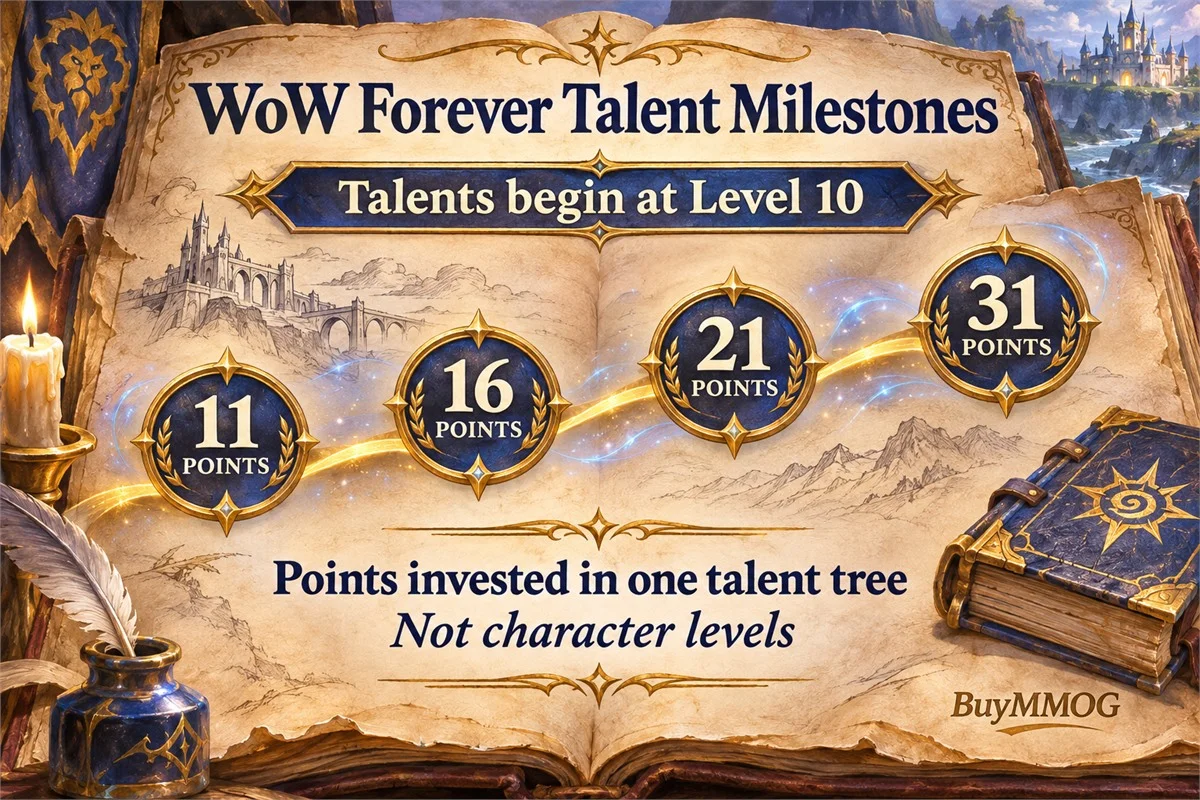
Your endgame goal can guide your choice without dictating every early decision. Decide whether most of your leveling will be solo, with one friend, or in a stable group; build around that reality first.
3. Class-by-Class Leveling Overview
The directions below are starting approaches to explore in the current talent trees. They describe what to prioritize, not a fixed point-by-point build for every level.
Hunter: Learn to Work With Your Pet
Starting direction: Beast Mastery is a sensible route to explore for a pet-centered character. Practice target selection and pet commands before increasing pull size. Keep enough space to use your ranged toolkit.
Forever detail: Pets gain stats from Hunter gear, and traps work in combat. Use those tools deliberately when a pull changes. For each awkward fight, identify whether the problem was positioning, pet control, or damage before changing the whole build.
Warlock: Balance Damage and Recovery
Starting direction: Explore Affliction for ongoing damage and draining, or Demonology for a stronger demon-focused identity. Keep track of both your resources and your companion.
Forever detail: Agony and Doom are Banes, separating their damage effects from utility Curses. Learn what each effect contributes instead of treating every debuff as another damage button. Begin with a repeatable single-target sequence before managing several enemies.
Druid: Pick One Main Job While Learning
Starting direction: Explore Feral for a shapeshifting melee approach, Balance for casting, or Restoration when regular healing is your plan. Learn one routine before practicing every role.
Forever detail: Equipped weapon DPS affects melee-form attacks. Compare weapon damage as well as attributes when evaluating an upgrade. Keep equipment appropriate to the job you accept; flexibility works best when you prepare before joining the group.
Paladin: Build a Clear Melee Routine
Starting direction: Consider Retribution for a damage-led questing plan; investigate Protection or Holy when your group needs a dedicated role. Keep healing and support abilities easy to reach.
Forever detail: Judgement does not consume the active Seal; Seal of Fury's Judgement provides a taunt. Learn the damage routine and tanking tools as separate jobs. Watch Mana across several fights, then choose a sustainable pace instead of judging a single burst.
Priest: Match Your Build to Your Actual Group Time
Starting direction: Explore damage-oriented choices for mostly solo questing, or healing-focused options for a reliable group. Shadow, Discipline, and Holy offer different priorities.
Forever detail: Fear Ward and Devouring Plague are available to every Priest at level 20. Factor them into your toolkit instead of choosing a race solely around their availability. Keep track of how often you actually heal before building your whole character around occasional runs.
Mage: Practice Control Before Larger Pulls
Starting direction: Frost is a useful control-oriented path to explore; choose Fire or Arcane if their spell interactions appeal more. Practice creating distance and recovering after a fight.
Forever detail: Frostfire Bolt arrives at level 40 and benefits from Fire and Frost interactions. That gives you a later build decision, not a reason to scatter early points. Make one-enemy encounters reliable before increasing pull size.
Rogue: Make the Opening of a Fight Count
Starting direction: Compare Combat for a weapon-led approach with Assassination or Subtlety if their particular tools appeal. Check weapon requirements before investing in a talent.
Forever detail: Poisons can coexist with temporary weapon enchantments. Compare the supplies available to your character instead of assuming you must choose between those effects. Use Stealth to plan an opener and a recovery option before engaging.
Warrior: Make Pull Size and Equipment Work Together
Starting direction: Explore Arms or Fury for damage-led leveling; prepare Protection when tanking is your main group job. Take weapon upgrades seriously and avoid adding enemies just because one fight went well.
Forever detail: Armor and damage-absorption effects do not reduce Rage gained from incoming damage. Plan defensive support with your group around that rule. If you tank, ask for manageable pulls and compare recovery as well as damage dealt.
Shaman: Use Support Tools With a Purpose
Starting direction: Explore Enhancement for melee, Elemental for casting, or Restoration for regular healing. Totems remain part of the class's identity.
Forever detail: Call spells let you prepare totem sets, while Totemic Projection moves placed totems. Build a setup for the encounters you actually take. More complete preparation is not automatically more efficient if it costs resources you did not need to spend.
4. Profession Pairings for Your First Character
You can learn two primary professions, plus all three secondary professions: Cooking, Fishing, and First Aid. The primary slots deserve a plan; you do not need to fill both with expensive crafting commitments immediately.
There are three practical starting goals: earn from materials gathered along your route, supply your own consumables, or craft equipment you will actually use. A profession pairing should support one of those goals.
| Character or goal | Pairing to consider | Why consider it? |
|---|---|---|
| Hunter / Rogue / Feral Druid | Skinning + Leatherworking | Connect collected hides with a relevant crafting path. |
| Mage / Priest / Warlock | Tailoring + a gathering profession | Work toward cloth crafts while keeping a material-income option. |
| Warrior / Paladin | Mining + Blacksmithing | Pair ore collection with weapons and armor crafting. |
| Enhancement Shaman | Skinning + Leatherworking | Consider equipment crafting if you enjoy that progression. |
| Consumable-focused player | Herbalism + Alchemy | Gather ingredients for potions rather than sourcing everything separately. |
| Gadget-focused player | Mining + Engineering | Combine resource collection with a utility crafting project. |
| Low-spending first character | Two gathering professions | Keep the initial plan focused on materials instead of leveling a craft. |
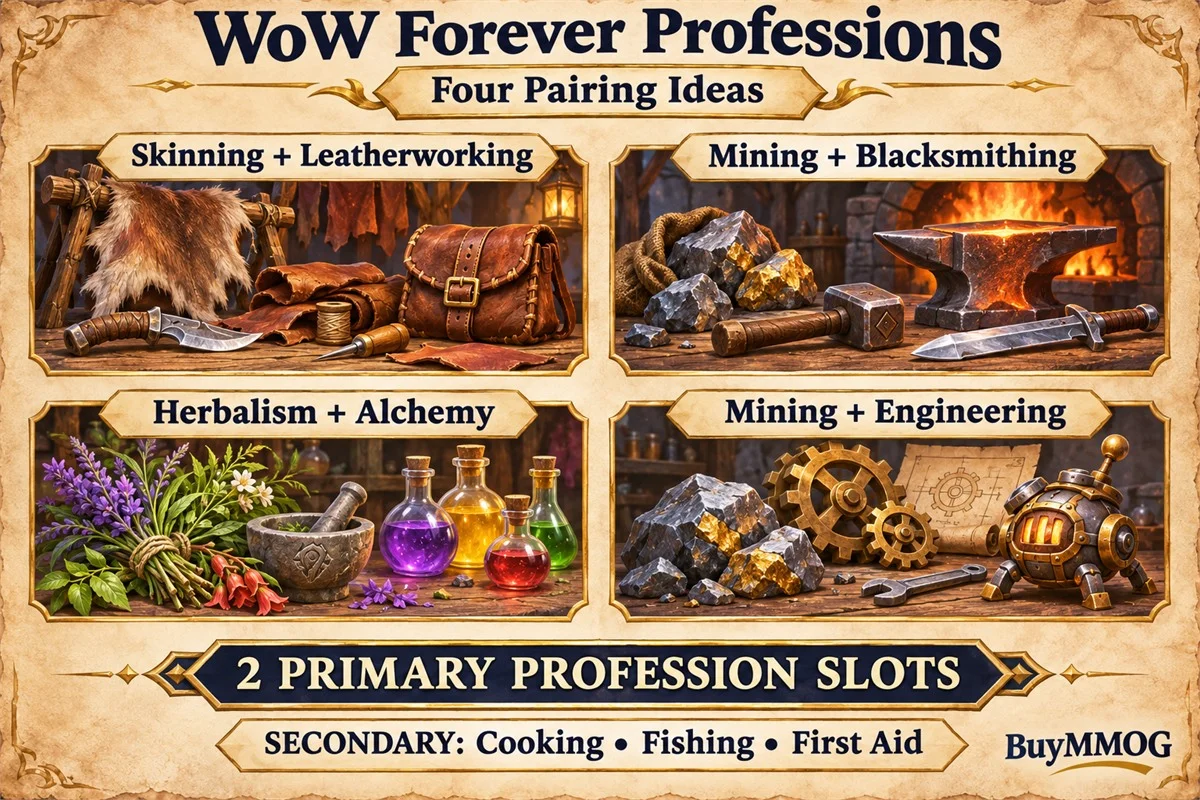
Alchemy is also worth considering on a casting or healing character; your class does not require you to choose the profession that makes its armor. Likewise, Engineering is an option for someone who wants its tools, not a compulsory choice for every character.
Give Crafting a Spending Limit
Choose a near-term craft or skill goal before buying materials. Then compare the cost of learning and making it with the alternatives available to your character. A recipe that is useful later does not automatically justify spending your current travel and training budget.
Check actual sale prices and whether goods sell before planning around a gathering income. Keep only the materials you have a use for; a full bank does not pay for your next purchase. Gathering can be a sensible starting plan without being a guaranteed profit strategy.
If you also plan to purchase currency, you can review BuyMMOG's WoW Forever Gold options. Confirm the game version, supported character options, current price, and delivery arrangements before ordering.
Include Secondary Professions and Campsites
Forever's Camping system gives professions another purpose. Leatherworking's Camp Tent supports Rested experience, while Skinning's Camp Chair supplies a critical-strike buff. Herbalism's Incense Candle grants Intellect but is exclusive with Arcane Intellect, so a Mage should not count it as an extra stacking Intellect bonus.
Think about the party as well as your own character. Campsite features can help fill a missing benefit; duplicating an exclusive buff is less valuable. Check a feature's requirements and effect before making it the reason for your profession choice.
5. Practical Starting Plans
Use these examples as decisions you can adapt. The aim is to leave character creation knowing what to practice and where your early resources will go.
Plan A: A Mostly Solo First Character
Example: Hunter, a pet-focused leveling direction, and gathering before a major crafting commitment. During your first sessions, practice selecting one target, directing your pet, keeping space, and recovering before the next fight.
Choose a small quest circuit and repeat the process until it feels predictable. When something goes wrong, review the first decision that caused trouble. If you keep restarting the same encounter, changing your approach is more useful than assuming a different class would solve it.
Plan B: Two Friends Who Want to Learn Together
Example: A Warrior and Priest, with complementary professions agreed in advance. The useful part of this plan is communication: discuss pull size, recovery, and when either player needs a pause.
Share a route and compare material needs before buying duplicates. Have a backup activity if one player is unavailable. A pairing that feels good together should still leave each person with something enjoyable to do alone.
Plan C: A Returning Player Who Wants Flexibility
Example: Druid with one main leveling job and a secondary role to learn gradually. Start by understanding the updated tools you use most often; postpone maintaining several complete gear plans until you know which roles you enjoy.
Set a review point after a few sessions: are you actually changing roles, or only paying to prepare for a possibility? Keep the flexibility you use and delay spending on the rest.
Plan D: A Profession-First Character
Example: Your preferred class with Herbalism and Alchemy, or a gathering-led plan. Set one attainable material or recipe goal per session. Keep enough time for character progression so the profession project does not make every login a shopping trip.
Record what you spent, what you crafted, and what you used or sold. That small record makes the next decision clearer than a generic claim about which profession earns the most gold.
Coordinating your first login across regions? Check our global release date and launch-time table.
6. Common Mistakes and FAQ
Four Mistakes Worth Avoiding
- Choosing for a role you rarely play. Plan for your ordinary sessions before optimizing an occasional activity.
- Copying an old build without reading it. Check current abilities, talent connections, and weapon requirements.
- Spending ahead of a clear goal. Know which immediate problem a new item or craft will solve.
- Changing everything at once. Adjust one part of your setup so you can tell whether it helped.
What is the best class for a beginner in WoW Forever?
Our first shortlist is Hunter, Warlock, or Paladin, depending on whether you prefer companions, spellcasting, or supportive melee. Choose by the responsibilities you enjoy, then use ordinary questing to test whether the rhythm suits you.
Which class should a solo player choose?
Hunter and Warlock are sensible starting candidates for companion-based play. Druid is worth considering for role flexibility. Treat the shortlist as a fit recommendation rather than a promise that one class is fastest in every situation.
Should I level with my planned endgame build?
Only if it supports the content you will actually play while leveling. A regular group and a mostly solo character may need different priorities. Revisit the plan as your activities change.
How many professions can I learn?
You can have two primary professions and all three secondary professions. Select the primary pair around a current goal; you do not need to maximize every skill immediately.
Are two gathering professions a good first choice?
They can suit a player who wants a simpler spending plan. Check material demand and the detours involved before assuming that gathering will pay well. Change the plan when you have a clear crafting goal.
Do I need the profession that crafts my armor?
No. Consider consumables, utility, material sales, and what you enjoy making as well. A profession is useful when you use its benefits; armor compatibility is only one reason to choose it.
How should I choose talents in Forever?
Use Forever-specific talent and ability information for your build. The weapon scaling, class tools, talent milestones, and profession campsite features discussed here affect decisions that an unrelated version's guide may handle differently.


