
Diablo 4
Doris
Season 16 PTR · Special Report
One ordinary Pit push, a screen full of greedy little monsters, and a loot explosion nobody expected. Here is what the Goblin Rift actually is, why it appeared on the PTR, how to chase it smartly, and what Season 16's new systems mean for every goblin you kill.
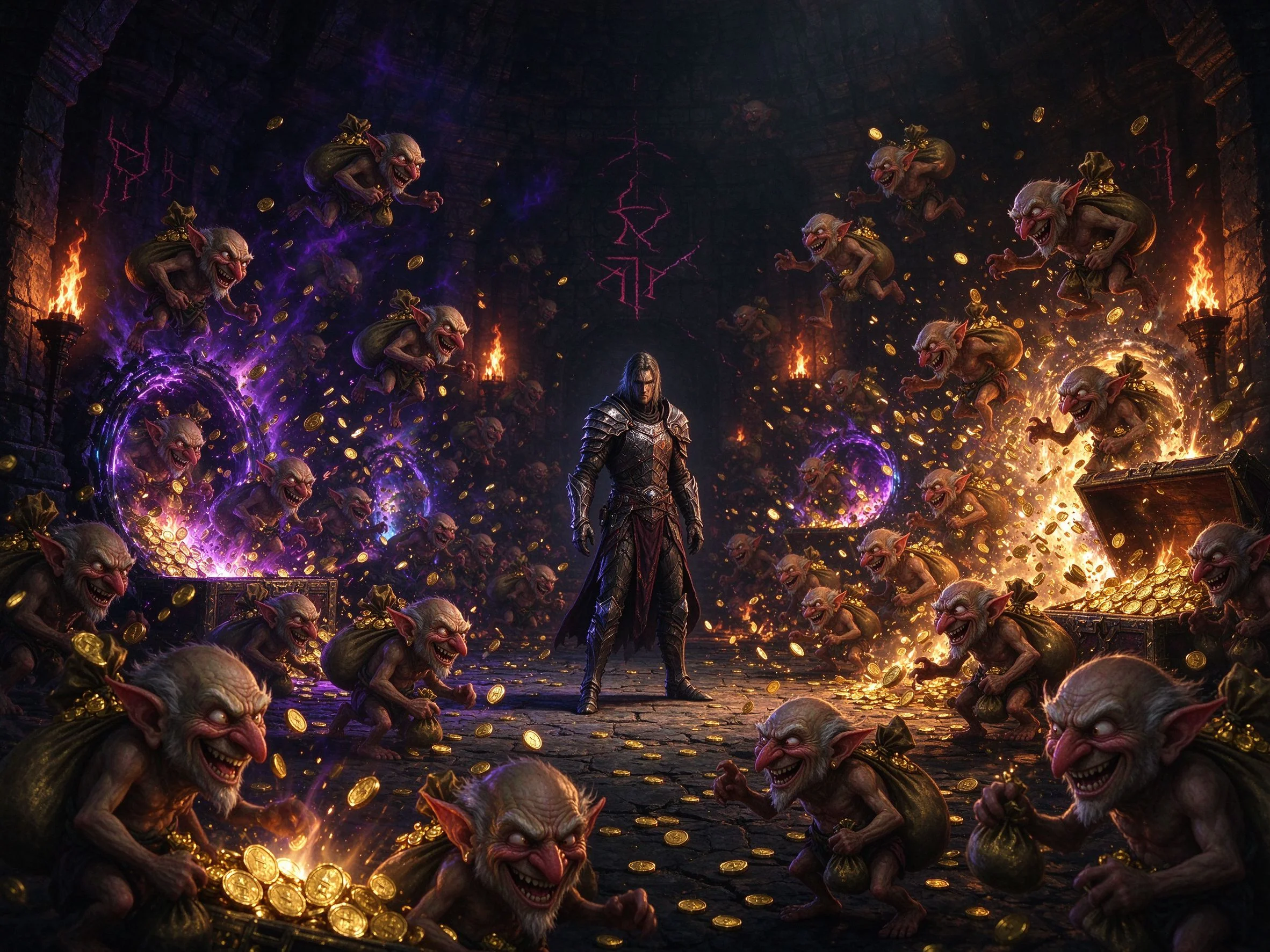
Picture this: you load into a Pit run on the Season 16 PTR — a normal glyph-leveling push, nothing special. A minute in, the screen fills with squealing, coin-rattling Treasure Goblins. Twenty of them. Maybe thirty. They scatter, they drop loot in waterfalls, and for a few glorious minutes the Pit stops being a DPS check and turns into a casino that pays out. This is the Goblin Rift, and it has become one of the most talked-about surprises of the entire 3.3.0 test. Below we break down what it is, why it happened, how to find it, the Season 16 systems that make it worth your time, and — most importantly — our honest opinion about what will actually survive to the live season.
In the days since the 3.3.0 PTR opened, a single story has rippled through the community: a player pushing a high-tier Pit suddenly ran into a fully loaded goblin invasion. In one run at roughly Pit tier 105, the floor turned into a treasure-goblin convention with an estimated 20 to 30 Treasure Goblins scattered across the level. Not a special event screen, no announcement, no warning — just a normal run that quietly became the best loot session of the week.
It is the kind of moment that makes you laugh out loud, scramble to kill everything in sight, and then immediately ask: "Was that real? Can I do it again?" The answer to the first question is yes. The answer to the second is… complicated. But before we get to the how, let us make sure we understand the what.
The Goblin Rift is a rare, special variant of the Pit — Diablo 4's timed endgame dungeon used to push tiers and level glyphs. When it triggers, the run stops being a linear DPS race and turns into a treasure-goblin hunting ground. Here is what makes it stand out:
That last point is quietly brilliant. In a normal Pit run there is no personal chest and no blacksmith, which means a full inventory usually forces you to abandon a push. The Goblin Rift removes that friction entirely, turning a pure speed-test into a nonstop loot session. For veterans, the whole thing also triggers a warm wave of nostalgia: it plays almost exactly like Greed Rift from Diablo 3, the beloved bonus level stuffed with golden monsters and mountains of treasure. Whether that resemblance is intentional or not, it landed.
The Goblin Rift did not appear out of nowhere. It is the result of two things happening at the same time on the PTR, and understanding both is the key to knowing how seriously to take it.
During the PTR, the March of the Goblins event appeared in-game before its reputation board was even functional. The early activation was confirmed as a bug — the event's real functions were meant to unlock later. But for a while, the increased goblin spawns the event brings were bleeding into everything, and players who hit the Pit during that window got to enjoy a preview of goblin heaven.
This is not a coincidence of one bug. Season 16's systems — from war-plan mechanics that spawn goblin altars and treasure breaches to event rewards tied to goblin kills — make goblins a central, repeatable part of the loop. The Goblin Rift sits right at the intersection of that theme and the event's early activation, which is why it showed up so dramatically.
Important caveat before you plan your whole season around it: PTR spawn density is not live-server density. Test realms exist precisely so Blizzard can measure, tune, and usually dial things back. The Goblin Rift is a fantastic experience to enjoy while testing — just do not treat 30 goblins per run as a promise for launch day.
Let us be direct: the Goblin Rift itself is random. There is no guaranteed trigger, and nobody has proven a deterministic recipe for it. What we can do is stack the odds — and, more importantly, show you the reliable goblin-generating methods that work whether or not the rift ever rolls for you. Here is the full toolkit, ordered from "most direct" to "most strategic."
The most honest answer is also the simplest: the Goblin Rift appears during Pit runs, so the more Pits you run, the more chances you have. High tiers seem to be where the magic shows up, and the Rift appears to be tied to the run itself rather than a specific tier. It is a numbers game. If you want to see one, put on a speed-farming build and grind Pits like it is your job.
Greed Shrines are special shrines that, when activated, make the monsters you kill spawn Treasure Goblins. This is the most reliable goblin engine in the game — but almost everyone uses it backwards. Here is the mistake and the fix:
❌ What 99% of players do wrong
They see a Greed Shrine, clear all the monsters around it first, then activate it. Result: nothing left to kill, zero goblins, wasted shrine.
✅ The correct sequence (memorize this)
The shrine window is short, so the golden rule is: kill first, loot later. One well-played Greed Shrine can out-produce an hour of aimless wandering.
This is the most sophisticated trick, and it turns a single good dungeon into a permanent goblin farm:
Dungeons with multiple shrines are the jackpot version of this strategy. A build with strong area damage and a mercenary that reveals enemies makes the loop dramatically smoother.
Season 16 adds War Plan Tactics, a meta-progression tree that lets you spend points to make the activities and rewards you want show up more often. If you want goblins, you can invest points so that Pit runs and Nightmare Dungeons appear more frequently in your offered war plans — which means more chances to roll shrine affixes and Greed Shrines. More details on the full system in the next section.
If you own Vessel of Hatred, your mercenary Subo is effectively a goblin radar. His recon ability reveals enemies on your map — and there is a zoom-level trick that most players never discover. Zoomed fully out, goblins are invisible. Zoomed in too close, they vanish again. But zoom the world map in exactly two levels, and goblins light up on your map at a much greater distance than anything else in the game. It feels almost like cheating, and it is legal.
Here is the part that actually matters beyond the PTR: even if goblin density gets tuned down at launch, Season 16 gives you a pile of new systems that make every goblin you kill — and every piece of loot it drops — far more valuable. This is where the real long-term strategy lives.
War Plan Tactics is a new meta-progression system that lets you tilt the odds of what appears in your war plans. You earn points by completing war-plan activities, then invest them in nodes:
Turning in completed war plans now rewards Marks of Wisdom, a new currency. Instead of paying gold, you can spend these marks to respec nodes in your War Plan Tactics tree and activity trees. On the PTR the cap is 20 marks — a soft limit that tells you to spend them thoughtfully rather than hoard them.
Tyrael's Blessings is a seasonal progress tree that customizes how your war plans pay out. Good news first: it is available to all seasonal players — no expansion required. You can earn up to 132 points, enough to make up to 4 of the 6 available choices across four paths. Here is the full menu:
| Path | What it does | Signature payoff |
|---|---|---|
| Curious Addition | Improves the Purveyor of Curiosities: higher chance of a second item, new item types, or better-quality gear. | Option to pay much more for a much higher chance of Tempered items — makes Obols genuinely valuable. |
| Mysterious Merchant | Adds a new vendor on Torment difficulties who sells chests for Forgotten Souls. | Paths toward Tempered chests, or rune/gem chests, or better and more Tempered chests. |
| Scent of Gold | More gold and experience from everything you do. | Branch into extra Horadric Cube materials and gem fragments, or have monsters drop more gold and gems; plus a legendary-item chance node. |
| Treasures from Scrap | Cheaper transmutation at the Alchemist and better Forgotten Soul odds. | More Obducite and Restoration Scrolls; salvaging Tempered items can refund scrolls; unlocks the Great Tempering recipe. |
Respec'ing Tyrael's Blessings costs 5,000,000 gold per point, so changes are possible but not cheap. Note that Tyrael's Blessings does not replace the existing Season Blessings — those become a static set of five, forming a reliable baseline under your new customization.
One of the biggest quality-of-life additions hides at the end of the Treasures from Scrap path: Great Tempering, a new Horadric Cube recipe. It takes an already-tempered affix on an item and upgrades it into a Greater affix — for the price of 30 Restoration Scrolls and 1,000 Obducite. In testing, a chest piece tempered with Maximum Life was converted directly into a Greater Maximum Life affix. No re-rolling, no praying to the RNG gods, no re-grinding the same temper — you targeted the exact affix you wanted and made it stronger. For anyone who has ever bricked a piece of gear on a bad temper roll, this is the system you have been begging for.
The death cult of Ullo Sar introduces Horadric Items — legendary items that create a direct link between your gear and your Talisman set bonuses. How they work depends on the slot:
The PTR test showed just how silly this can get: a Sorcerer build had the five-piece bonuses of Shadows of Harash and Rite of the Nameless active at the same time, and Horadric items were rolling monster stats — up to six extra skill ranks, 16% maximum life, 16% cooldown reduction, 30% damage reduction, and 30% dominance generation. Yes, that is as broken as it sounds. Expect the live season to trim the sharpest edges, but the core idea — letting gear plug into set bonuses — is a genuinely fresh direction.
Tied to the Mysterious Merchant path, a new vendor sells chests in exchange for Forgotten Souls — and those chests can hold a surprising number of Tempered items. His stock is limited and refreshes after a wait, which does two interesting things at once: it gives Forgotten Souls a meaningful sink beyond enchanting, and it hands you another steady source of build-relevant gear. Combined with the Purveyor changes, it also quietly makes Obols worth far more than they used to be.
If you fight your way past all the goblins, Season 16's headline boss encounter is a nasty twist: the Fractured Soul Reaper joins the Corrupted Soul Reaper from the previous season, and the two fight together as a synchronized pair, layering their abilities in ways that will shred any build that is not fully built out. The loot is described as epic — the fight itself is the filter. Bring your best, because the goblin party ends the moment these two show up.
Enough mechanics. Here is the part where I give you an honest opinion instead of another checklist. The Goblin Rift is fun, but the more interesting story is what it tells us about where Diablo 4 is heading.
Opinion 1: This is the spiritual successor to Diablo 3's Greed Rift — and that is a good instinct.
Blizzard clearly knows that the "low barrier, huge dopamine spike" moment is what keeps loot games alive. The Goblin Rift is a love letter to that idea: no build requirements, no strategy, just ten seconds of setup and a screen full of treasure. Moments like this are why players come back after every season reset, and I hope they keep designing more of them.
Opinion 2: The chest-and-blacksmith inside the Pit is the real design signal.
Everyone is talking about goblin numbers, but the genuinely smart change is giving the player a personal stash and a blacksmith mid-run. That is Blizzard finally admitting that inventory friction — the "run is over because my bag is full" feeling — was a problem worth solving. That kind of QoL thinking improves every single run, goblins or not. I would happily trade lower goblin density to keep that feature forever.
Opinion 3: Randomness cuts both ways — the live season needs a pity system.
Some players report swimming in goblins; others run Pits all week and see nothing. That is the double-edged sword of rarity: it makes the encounter thrilling when it happens, but it also manufactures frustration for everyone it never visits. If the Goblin Rift ships as a live feature, I strongly believe it needs a soft guarantee — a pity counter, a spawn-rate ramp, or an event window — so that "eventually you WILL see one" is true and not just a prayer.
Opinion 4: War Plan Tactics is "voting with points" — a good direction with a convergence risk.
Giving players agency over what appears in their war plans is genuinely player-friendly. My concern is that optimization always wins: within a week of the live season, there will be one "correct" allocation per activity type, and everyone will run the same tree. The system is only as diverse as the builds it serves. I would love to see nodes that reward unusual choices rather than just amplifying the obvious ones.
Opinion 5: Great Tempering is the right answer to affix RNG fatigue — but check the price tag.
Tempering was the most frustrating RNG layer in recent seasons, and Great Tempering finally gives you a deterministic upgrade path. But 30 Restoration Scrolls and 1,000 Obducite per conversion is not pocket change. The math only works if you are upgrading a genuinely excellent piece — use it on a mid-tier item and you will feel the sting. Treat it as an endgame investment, not a convenience.
Opinion 6: Do not bet your live-season plans on PTR goblin density.
The 20–30 goblin runs are a test-realm phenomenon fed by an event that activated early. Blizzard tunes PTR numbers down all the time — that is literally what the PTR is for. Build your live-season strategy around the systems (Tactics, Blessings, Great Tempering, Horadric items), because those are staying. Treat the goblin jackpot as the delicious dessert it is, not as the main course.
Opinion 7: Forgotten Souls are becoming the season's real currency — stock up early.
Between the Mysterious Merchant's chests and the Treasures from Scrap path, Forgotten Souls are no longer a passive side material — they are a buying power. Players who recognize this early will have a massive head start on gear and Tempered items. If you are planning the live season, start thinking about your Forgotten Soul income now, not in week three.
Everything above, compressed into a checklist you can screenshot and keep on a second monitor:
The Goblin Rift is the most delightful surprise of the Season 16 PTR — a loud, golden, ridiculous moment that reminds you why you fell in love with loot games in the first place. It is also a trap, if you let it become the only thing you chase. The encounter is random. The systems around it are not.
Season 16 is quietly one of the most ambitious seasons Diablo 4 has shipped: War Plan Tactics gives you control over what you grind, Tyrael's Blessings lets you sculpt how it pays out, Great Tempering removes one of the worst RNG feels in the game, and Horadric Items open up set-bonus combinations that never existed before. Any one of those would be a solid season. All of them together are a statement of direction — and the goblins are just the fireworks on top.
So here is my honest advice: enjoy every goblin the PTR throws at you, memorize the shrine technique, learn the dungeon loop, and then spend your real planning energy on the systems that will still be standing when the density is tuned back to normal. Test hard, report what feels broken, and let the feedback shape the season. And if you finally see a screen full of Treasure Goblins on the live server — drop everything, laugh, and enjoy the moment. That is the whole point.
Happy hunting, wanderer. May your next Pit run be full of goblins.