
EA SPORTS FC 27 Legendary Difficulty: Extreme Snowy Weather Survival & Tactics Guide
FC 27 News

EA SPORTS FC 27 Legendary Difficulty: Extreme Snowy Weather Survival & Tactics Guide

FC 27 Jovie

📑 Table of Contents

1. Introduction: What Is Extreme Snow‑Blizzard Weather in FC 27

Extreme blizzard snow weather stands out as one of the most distinctive environmental systems inside EA SPORTS FC 27. For players fighting on Legendary AI difficulty, snow matches can quickly turn frustrating. This weather condition is far more than just cosmetic visual flair; it actively alters player performance on the pitch, drains stamina faster, and raises overall pass error rates. The Legendary‑level AI also benefits from subtle environmental advantages in these snowy fixtures.

This guide combines visibility‑focused optimization strategies and proven real‑match tactical advice. Many gamers simply reuse their regular sunny‑day tactics and end up suffering repeated defeats in snow games. The key to consistent results lies in understanding how weather reshapes gameplay and adapting both your visual settings and in‑game football strategy accordingly.

2. Core Game Mechanics of Snow‑Blizzard Matches

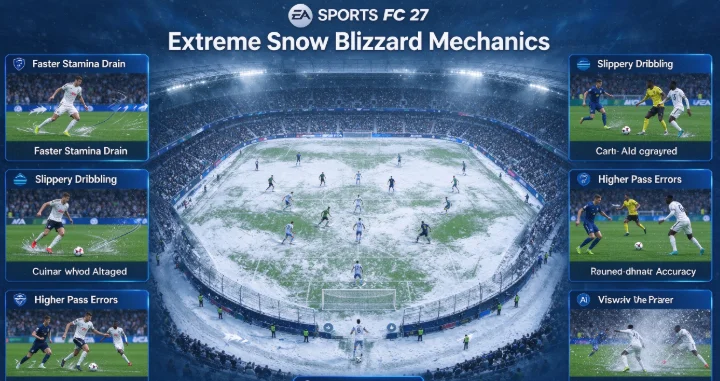
Blizzard weather applies tangible penalties across every player on the field. Stamina depletion speed is noticeably increased for all athletes. Dribbling control becomes less reliable; players slip more easily while performing direction changes. Both short and long passes show a higher chance of going astray, and long‑range shooting accuracy receives a clear negative modifier.

When playing against Legendary difficulty AI, there is an important hidden factor to consider: computer‑controlled teams receive reduced environmental penalties on snow. The AI comfortably exploits slippery pitch conditions by launching frequent long‑ball counter‑attacks, targeting your slower‑turning defenders.

The biggest challenge of snow matches is not raw AI power itself. Instead, your well‑honed regular‑weather gameplay habits simply stop working. Skill‑moves, constant high‑pressure pressing and long‑distance shooting that perform well on dry grass become risky choices on a slippery snow‑covered pitch.

Visual obstruction is another major issue. Heavy snow particle effects can partially obscure player runs and the football itself, creating visibility headaches across both PC and console platforms.

3. Graphics & Visibility Optimization Solutions

If you cannot clearly track the ball and player movement, even solid tactical knowledge will not help you win snow matches. Two distinct configuration paths are provided below: performance‑first for competitive wins and immersion‑first for casual simulation play. It is not recommended to turn down every graphics setting to absolute minimum values without careful consideration.

Option 1: Performance‑First Setup (For Legendary Wins, PC & Consoles)

  • Reduce snow & blizzard particle effects; these particles are the primary source of washed‑out screen visuals.
  • Keep player model and pitch material quality intact. Lowering player detail will make it harder to distinguish teammates and opponents.
  • Turn off motion blur completely, as it worsens disorientation during heavy snowfall.

Option 2: Immersion‑First Setup (Casual Gameplay)

  • Maintain snow particle settings at a medium level to preserve wintry atmosphere.
  • Disable motion blur.
  • Turn on on‑screen player name HUD markers to compensate for snow‑related vision loss.

Many online guides suggest dropping all visual settings to minimum. While this improves clarity, it also removes the intended environmental gameplay feature. Unless you repeatedly struggle to see the ball, try medium snow particle values combined with HUD assistance before fully disabling weather visuals.

4. Offensive Tactics for Legendary‑Difficulty Snow Matches

Your attacking game plan needs to be reworked for slippery snowy conditions. Reliable sunny‑day strategies will suffer reduced effectiveness on snow‑covered turf.

  • Dribbling: Cut back on fancy skill moves. Slippery ground drastically lowers dribbling tolerance, and risky tricks often result in accidental ball loss. Progress the ball mainly with safe short passes; only perform small‑scale direction changes when plenty of open space is available.
  • Shooting choices: Avoid long‑range power shots from outside 30 meters, as snow heavily penalizes long‑shot accuracy. Inside or near the penalty box, prioritize finesse curl shots aimed toward the far post. Hard power strikes are best reserved for tight, close‑range box opportunities only.
  • Crossing from the flanks: Exercise caution with high‑wing crosses. Snow disturbs ball flight paths and makes aerial crosses inconsistent. After reaching the by‑line, look for cut‑back short passes back toward the top of the penalty area instead of looping high crosses into the box.
  • Through balls: Restrict your usage of over‑the‑top through passes. Snow‑affected passing mechanics raise misfire odds. Only send through balls when you spot a clear, sizable gap inside the defensive line.

5. Defensive Tactics Under Blizzard Weather

Defensive mistakes carry heavy consequences during snow matches. Once the AI launches a long‑ball counter‑attack, your slow‑turning slipping defenders will struggle to recover ground.

  • Avoid constant full‑field pressing: High‑intensity hold‑button pressure works well in dry‑weather matches, but avoid spamming it on snow. Sprinting wears down stamina rapidly and your defenders risk slipping out of position after committing to a challenge. Use controlled, local pressure with one player while keeping remaining teammates in stable defensive formation.
  • Never drag centre‑backs forward manually: One of the most common defensive errors is pulling your central defenders out of the backline to chase the ball. Leave centre‑backs anchored deep. If you want to apply pressure further upfield, send midfielders forward to intercept passes and preserve your defensive core.
  • Countering AI long‑ball tactics: Legendary AI heavily favours long‑ball counter‑attacks on snow. Prioritize reading passing lanes and taking up good positions. Do not lunge recklessly into tackles; sometimes conceding extra ground is safer than committing to a risky challenge that leaves you beaten.

6. Squad Building & Critical Stamina Management

Stamina conservation becomes your top survival priority for blizzard fixtures. Snow conditions accelerate stamina drain significantly, and poor stamina management frequently results in total squad fatigue late in the second half.

  • Player attribute priorities: When selecting your starting eleven, prioritize high Stamina, Balance, and Strength ratings. Players with low Balance stats slip more often on turns and dribbles. Small, agile players with weaker physical profiles tend to under‑perform noticeably under snowy conditions.
  • Substitution rotation strategy: Do not wait until the 75‑minute mark to make changes. Try rotating out 1‑2 fatigued midfield or wide players at half‑time. Late second‑half represents the highest risk window for conceding goals when playing Legendary difficulty snow matches, so fresh reserve players provide valuable insurance.
  • Tactical board parameter tweaks: Lower team aggression for pressing and slightly reduce your general sprint frequency inside custom tactics. Shift passing preferences toward shorter build‑up play, and dial back automatic through‑ball tendencies. Adjust your in‑game tactics to work with snow‑based constraints instead of forcing dry‑weather settings.

7. Frequent Player Pitfalls & Mistakes To Avoid

  • Reusing sunny‑day tactics unchanged: Continuing to spam skill‑moves, high‑line pressing and long‑shot attempts ignoring snow‑based penalties is the primary cause of repeated losses on Legendary difficulty.
  • Extreme graphics adjustments: Maxing out snow particles results in an obscured view of play; dropping every visual slider to minimum removes the intended weather simulation experience.
  • Mis‑positioning centre‑backs: Manually pulling central defenders forward to apply pressure rips apart your defensive backline and opens huge gaps for AI long‑ball counters.
  • Ignoring stamina rotation: Making zero substitutions until late in the match leaves your whole team fatigued, leading to sloppy passing and slow defensive movement for the final 15‑20 minutes.

8. Two Complete Practical Playstyle Templates

Template A: Competitive Win‑Oriented Template (Beat Legendary Snow Matches)

  • Graphics: Lower snow particle intensity, motion blur off, keep player & pitch textures high, enable player‑name HUD.
  • Tactics: Reduce team pressing level, build attacks via short passes, limit through‑balls & frequent crossing; use controlled local pressure only, keep centre‑backs deep.
  • Squad: Start players with strong stamina and balance; substitute at least one‑two midfield or wide athletes during half‑time break.
  • Attack mindset: Focus on finesse curl shooting near penalty box, avoid long‑range power shooting attempts.

Template B: Immersion‑Focused Casual Template (Weather Simulation Experience)

  • Graphics: Keep snow particles at medium setting, disable motion blur, leave all HUD indicators turned on.
  • Tactics: Retain parts of your preferred regular‑match tactics, but scale back aggressive high pressing; still perform moderate substitutions to prevent total stamina exhaustion.
  • Mindset: Accept an increased number of unforced player errors; treat blizzard conditions as a unique simulation feature without strict pressure to win every fixture.

9. Final Evaluation & Closing Thoughts

Extreme snow blizzard gameplay in EA FC 27 delivers mixed results overall. On the positive side, it greatly elevates simulation‑style immersion, integrating real‑world weather influence directly into match‑to‑match gameplay rather than functioning purely as decorative visual effect. However, there are noticeable downsides as well. On Legendary difficulty, the inconsistent weather‑penalty balance between human players and AI creates occasional frustration, alongside visibility issues during peak snowstorm intensity.

For competitive players chasing wins, use the competitive‑oriented template, rework your tactics and carefully manage player stamina to adapt to snow‑covered pitch constraints. For casual simulation‑focused gamers, the immersion‑first setup lets you enjoy the wintry match atmosphere without heavy win‑loss pressure. It is not recommended to either fully ignore weather mechanics or completely erase snow‑weather visual effects entirely.

Ultimately, finding consistent success in blizzard‑affected fixtures does not depend solely on raising raw mechanical skill. Victory comes by acknowledging environmental limitations and actively adjusting graphics settings, squad selection, and tactical instructions to work alongside the snow‑covered pitch conditions.

Prev: FC 27 Collection Explained: How Ratings, Tokens & Rewards Really Work
Recommended Article
EA SPORTS FC 27 Closed Beta Deep Dive: Core Gameplay Changes & Reskin Debate
payment icon
Copyright© Buymmog.com all rights reserved.   This website is owned and operated by JINKING KAK LIMITED.