
Palworld
Jack
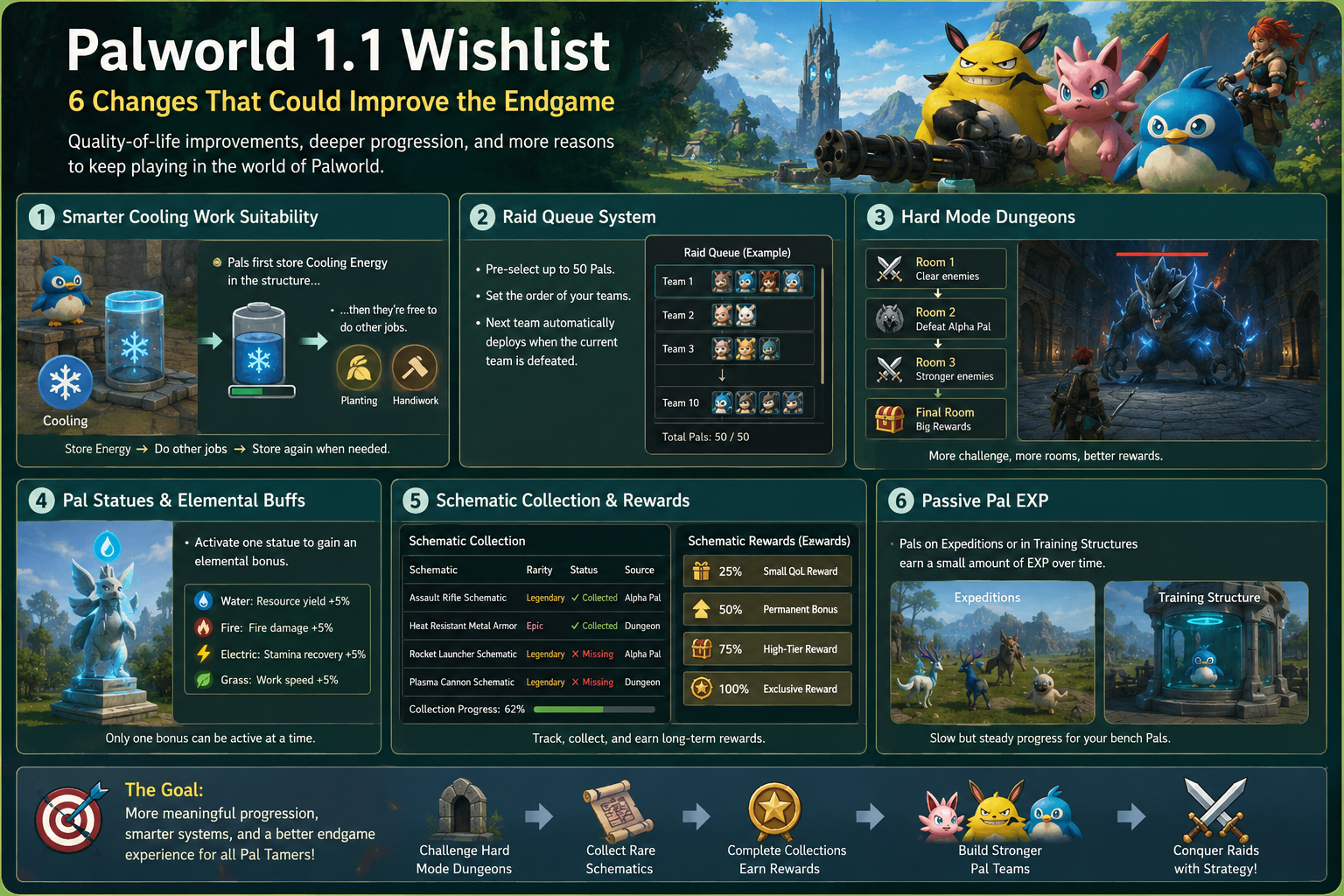
What should Palworld improve next? From a smarter Raid Queue system and more rewarding Hard Mode Dungeons to Schematic collections and better Pal progression, there are plenty of ways a future update could make both everyday gameplay and the endgame more satisfying.
Palworld already gives players a huge amount to do, but after spending dozens or even hundreds of hours exploring, building teams, collecting Pals and preparing for late-game encounters, some weaknesses in its progression systems become much easier to notice.
That is why the next major Palworld update has so much potential.
The exact content of Palworld 1.1 is still not the focus here. Instead, this article is a wishlist built around several changes that could improve existing systems rather than simply adding more content.
Some of the best updates are not necessarily new islands, dozens of new Pals or another massive boss. Sometimes a relatively small system change can completely transform how enjoyable the game feels.
Raid preparation could be less frustrating. Dungeons could remain useful after reaching the endgame. Old Schematics could become worth collecting again. Base Pals could work more efficiently, and unused Pals could have better ways to gain experience.
With that in mind, here are the Palworld 1.1 changes we would most like to see.

One relatively small Palworld improvement could make base management noticeably more efficient: changing how Cooling Work Suitability operates.
Cooling currently requires a Pal to remain committed to keeping the relevant structure cold. That creates an awkward situation for Pals that have Cooling alongside another useful Work Suitability.
The Pal may technically be capable of performing multiple jobs, but in practice its Cooling responsibility can prevent the player from taking full advantage of those additional abilities.
A better solution would be to make Cooling behave more like a stored-energy system.
This would not make Cooling irrelevant. Players would still need suitable Pals and sufficient cooling capacity, but those Pals would no longer have to spend nearly all of their useful time locked to one task.
It is exactly the kind of quality-of-life change that sounds small on paper but could make automated bases much more satisfying to optimize.
Of all the ideas on this wishlist, a dedicated Raid Queue system could have one of the biggest effects on Palworld's endgame.
Raid battles encourage players to prepare large numbers of powerful Pals. The problem is that managing those Pals during an active fight can become unnecessarily awkward.
Instead of focusing entirely on the boss, players may find themselves returning to the Palbox to replace defeated Pals and reorganize the next wave.
That is management, but it is not particularly interesting management.
A Raid Queue would move those decisions to the preparation stage.
Before activating a raid, players could select a much larger pool of Pals — for example, up to 50 — and determine the order in which different groups enter battle. Once the active group is defeated, the next prepared group would automatically deploy.
The existing active-Pal limit would not necessarily need to disappear. The game could still restrict how many Pals fight simultaneously while allowing the player to prepare several waves beforehand.
That distinction is important because simply allowing 50 Pals onto the battlefield at once would introduce performance and balance problems.
A queue solves the management issue without turning the raid arena into complete chaos.
The biggest advantage of a Raid Queue would not simply be convenience. It could make raid preparation more strategic.
Imagine a raid boss with multiple phases.
Instead of throwing every strong Pal you own into the same group, you could prepare several specialized teams.
| Raid Group | Possible Role | Strategy |
|---|---|---|
| Team 1 | Opening Phase | High sustained damage and survivability |
| Team 2 | Second Phase | Elemental advantage against a changed boss form |
| Team 3 | Final Push | Maximum damage reserved for the final phase |
This would make the order of your Pals meaningful.
Perhaps the first group is built around durability. The second group exploits an elemental weakness. The final group contains your strongest damage dealers and is deliberately saved until the boss reaches its most dangerous phase.
The result would be more preparation before the raid and less menu management during it.
It would also give players a stronger reason to raise more than one perfect team. A wider roster would have genuine tactical value because different groups could perform different jobs.
Dungeons are exciting during progression because they offer exploration, enemies, resources and the possibility of valuable rewards.
Their value can decline once a player reaches the late game, however. When your equipment and Pal roster are already powerful, ordinary dungeon rewards become less compelling.
A Hard Mode Dungeon system could change that.
Similar to the concept of harder versions of existing boss encounters, upgraded dungeons could become optional endgame challenges unlocked after reaching certain progression milestones.
Instead of rushing through a familiar dungeon and defeating one Alpha Pal at the end, a Hard Mode version could contain several combat rooms.
The reward pool would be just as important as the difficulty.
Harder content needs rewards that late-game players actually want. Better chances at valuable Schematics and other useful endgame items would give players a reason to repeatedly challenge these dungeons.
This would not require replacing normal dungeons. Regular versions could remain part of natural progression, while Hard Mode becomes an optional challenge for players who have already built powerful teams.
Palworld has plenty of opportunities to make bases feel more personal, but one particularly interesting idea would combine customization with actual gameplay progression: functional Pal Statues.
Instead of existing purely as decoration, different Pal statues could provide a small passive bonus based on the Pal's elemental type.
For example, placing or activating a Water-type Pal Statue could provide a Water-related bonus. A Fire-type statue could provide a different benefit.
The exact numbers would obviously need balancing, but possible bonuses could include:
To prevent players from stacking every bonus simultaneously, only one statue effect could be active at a time.
That limitation would turn statues into another strategic choice. Before fighting a difficult boss, players might return to base and activate the statue bonus most useful for that encounter.
More importantly, it would give players another reason to interact with their base beyond production efficiency.
Schematics are one of Palworld's most natural collectible systems, yet the game could do much more with them.
Players can spend a huge amount of time hunting specific high-level Schematics, but keeping track of what has already been obtained and what is still missing can become inconvenient.
A dedicated Schematic Collection menu could solve that.
The menu could display every important Schematic and clearly indicate whether the player has collected it.
The acquisition information is particularly important.
Instead of forcing players to remember which Alpha Pal, dungeon or activity is associated with a particular Schematic, the collection menu could provide a useful hint about where to search.
It would turn Schematic hunting into a clearly visible progression goal.
Simply displaying Schematics in a menu would be useful, but the system could go one step further.
One problem with loot progression is that older equipment naturally becomes irrelevant. Once a player owns superior late-game gear, there is little gameplay reason to hunt a Legendary Schematic for an early weapon they no longer use.
Collection milestones could give those older Schematics a new purpose.
| Collection Progress | Example Reward Concept |
|---|---|
| 25% | Small quality-of-life reward |
| 50% | Minor permanent progression bonus |
| 75% | Higher-tier collection reward |
| 100% | Exclusive completion reward |
These rewards would need to remain relatively small. The purpose should not be to force every player to collect every Schematic just to remain competitive.
Instead, the system should reward completionists while giving ordinary players another long-term objective.
This would also create an interesting connection with Hard Mode Dungeons. If difficult dungeons provide better opportunities to obtain rare Schematics, and those Schematics contribute toward a visible collection, the two systems reinforce each other.
Rare drops are only one part of late-game progression. Players who want to spend less time gathering everyday supplies can also check Palworld Items at BuyMMOG for useful in-game items, materials, ammo, consumables, Spheres and other resources that can help with preparation.
Another useful quality-of-life improvement would be a limited way for Pals outside the active party to earn experience.
Palworld's late-game activities can encourage players to maintain a much larger roster than the few Pals they regularly carry in their party.
Raids in particular make additional high-level Pals valuable, but repeatedly leveling every Pal needed for specialized teams can become a grind.
Expeditions provide a natural opportunity to improve this.
Pals assigned to Expeditions could receive a modest amount of EXP after successfully returning. Another possibility would be a training structure that slowly develops Pals placed inside it.
The important word is slowly.
Passive EXP should not replace active leveling or instantly create max-level raid armies. It should simply allow unused Pals to make gradual progress while the player focuses on other activities.
What makes these ideas interesting is how naturally they could connect with each other.
They do not need to exist as six completely separate features.
Meanwhile, passive EXP could help secondary Pals gradually become raid-ready, and Pal Statue bonuses could provide another layer of preparation before particularly difficult encounters.
That is a much more interesting endgame loop than simply increasing enemy health or adding another item with a slightly larger damage number.
The best progression systems give players several reasons to participate in existing content.
Hard Mode Dungeons would make exploration relevant again. A Schematic Collection would make old loot relevant again. Raid Queues would make larger Pal rosters relevant. Passive EXP would make raising those larger rosters less repetitive.
Each feature solves a different problem, but together they could make Palworld's late game feel considerably more connected.
Palworld does not necessarily need every future update to completely reinvent the game.
Improving the systems players already use could be just as valuable.
A Raid Queue could remove frustrating Palbox management while adding more strategy to boss preparation. Hard Mode Dungeons could give powerful players a reason to return underground. A proper Schematic Collection could turn forgotten loot into meaningful long-term progression.
Smaller changes such as improved Cooling behavior and passive Pal EXP could make everyday progression smoother, while functional Pal Statues could introduce another interesting layer of specialization.
None of these ideas need to dramatically change what Palworld is. That may actually be their greatest strength. They build on systems that already exist and attempt to make them more useful, rewarding and enjoyable.
Whether you are preparing powerful Pals, stocking resources for difficult encounters or simply want to reduce some of the repetitive item grind, BuyMMOG offers Palworld items for players who want a faster way to get what they need.
View Palworld Items at BuyMMOG