
FC 27
Jack
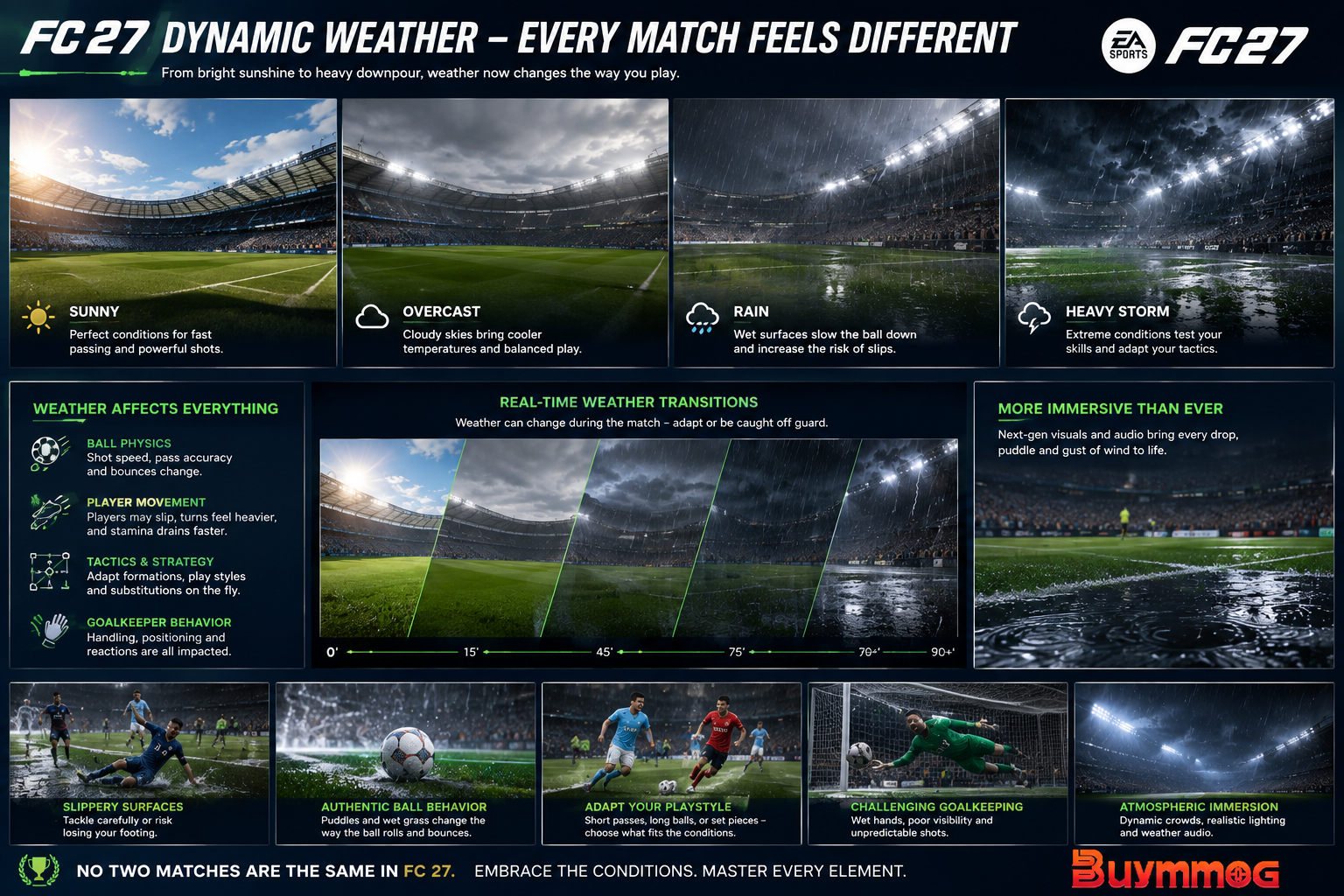
EA Sports FC 27 could take another major step toward realistic football with a dynamic weather system capable of changing conditions while a match is being played. If the reported system works as expected, sunshine could turn into rain, storms or even snow — and those changes may affect much more than the appearance of the pitch.

Weather has existed in football games for many years, but it has usually been a relatively static part of the presentation. A match starts under certain conditions and those conditions generally remain recognizable throughout the game.
The reported FC 27 system would potentially take a different approach. Instead of treating weather as background decoration, conditions could evolve while the match is taking place.
Imagine starting a match under clear skies. Clouds gradually arrive during the first half, rain begins around halftime, and the second half is played on an increasingly wet pitch. That transition could create a much more convincing match-day atmosphere — especially if the changing conditions also interact with gameplay.
One of the most interesting possibilities is real-time weather progression. Rather than choosing a simple "sunny" or "rainy" setting before kickoff, a match could move through several different conditions.
The biggest benefit would be unpredictability. Two matches played in the same stadium would no longer necessarily feel identical, while players could be forced to react to conditions instead of simply repeating the same approach for 90 minutes.
This is where dynamic weather could become much more important than a visual upgrade. If FC 27 connects weather conditions with its physics systems, a wet pitch could potentially change how the ball moves across the grass.
Possible effects could include:
These details could make weather tactically relevant. A passing pattern that feels reliable during the opening 30 minutes might become more dangerous once heavy rain changes the pitch.
However, EA would need to be careful. Weather should create believable variation without making player input feel random or inconsistent.
Ball physics are only one part of the equation. Wet or snowy conditions could also influence the players themselves.
Heavy rain could theoretically reduce stability when turning sharply, make difficult first touches less reliable and increase the risk associated with aggressive dribbling.
That would be particularly interesting for players who rely heavily on quick direction changes and repeated skill moves. Good weather might favor technical possession football, while difficult conditions could increase the value of strength, positioning and simpler decision-making.
This could be the most exciting part of the entire system.
Football games naturally develop dominant strategies. Once the community discovers an especially effective formation, pressing setup or attacking pattern, many competitive matches begin to feel similar.
Dynamic conditions could add another variable that players have to read during the match. For example, a team using fast short passes and aggressive dribbling in the first half might need to simplify its approach when heavy rain arrives.
If implemented carefully, this would reward players who can read a match rather than simply execute one optimized system from kickoff to the final whistle.
Another exciting possibility is stronger regional identity. Football played in northern Europe in winter should not always look and feel the same as football played in Spain, Italy or another warmer environment.
Snow-covered surroundings, cold-weather lighting and visible player breath could make winter fixtures feel much more authentic. Combined with stadium-specific presentation, those details could give individual venues and leagues more personality.
This may sound cosmetic, but presentation matters enormously in Career Mode. When players complete several seasons with the same club, environmental variety can help prevent matches from feeling repetitive.
Competitive modes would receive most of the attention, but Career Mode may actually be the perfect environment for a dynamic weather system.
Imagine playing an important January relegation match during freezing conditions. Snow begins falling, the pitch becomes more difficult, tired players struggle late in the game and the manager has to reconsider substitutions.
Weather could potentially interact with stamina, substitutions, tactical choices and squad rotation. Even relatively small effects could make a long Career Mode season feel more alive.
| Condition | Possible Challenge | Possible Response |
|---|---|---|
| Heavy Rain | Slippery pitch and difficult control | Safer passing and fewer risky touches |
| Snow | Potentially slower or less predictable play | More physical and direct football |
| Changing Conditions | Original game plan becomes less effective | Formation or personnel changes |
Ultimate Team raises a more complicated question. Dynamic weather could make competitive matches more varied, but EA would need to ensure that conditions do not create unfair advantages or excessive randomness.
If weather has meaningful gameplay effects, squad construction could become more interesting. Instead of building an XI around only one style of football, players might benefit from having alternatives available on the bench.
A technical midfielder could be ideal when the pitch is dry and possession is easy, while stronger midfielders or forwards could become more useful when difficult conditions encourage more physical or direct football.
If FC 27 makes tactical flexibility more important, having greater squad depth could become valuable in Ultimate Team. Players preparing their squads for the new season can check FC 27 Coins at BuyMMOG when looking for another way to build or upgrade their Ultimate Team and add players suited to different tactical situations.
There is an important balance issue here, though. Competitive players generally want matches to be decided by skill rather than uncontrollable environmental effects. EA would therefore need to keep weather predictable enough for players to adapt to it.
One possible solution would be stronger weather effects in offline and Career Mode matches, with more controlled implementation in highly competitive Ultimate Team modes.
Part of the speculation surrounding FC 27 comes from EA's experience with its other sports franchises. Madden provides an obvious reference point because American football games have experimented with environmental conditions and weather-related presentation.
The important point is not simply whether EA can create convincing rain or snow. Modern game engines can already produce impressive weather effects. The real challenge is connecting those effects to football gameplay in a way that feels natural.
Football involves continuous movement, precise passing, first touches and dribbling. Even small changes to friction or responsiveness can dramatically affect how a football game feels.
Dynamic weather is not the only idea being discussed around FC 27. Reports have also pointed toward technologies designed to make individual footballers look and move more like their real-world counterparts.
One particularly interesting direction is improved optical tracking. Better real-world motion data could potentially help EA differentiate running styles, shooting animations, dribbling movements and other player-specific actions.
If successful, that would address one of the long-standing challenges for football games: making elite players feel unique because of how they move rather than simply because their attributes are higher.
There have also been discussions and rumors surrounding more social or open-world-style experiences. Such ideas should be treated cautiously until EA provides official details, but they suggest that FC 27 could aim for broader changes than a traditional annual update.
Dynamic weather has the potential to be one of FC 27's most interesting additions because it could improve both realism and tactical variety at the same time.
But there is a major difference between weather that looks realistic and weather that creates good gameplay.
If every rainy match produces constant slips, bad touches and unpredictable passes, players could quickly find the system frustrating. On the other hand, if weather barely affects anything, it becomes little more than an expensive visual effect.
That is where the feature could genuinely improve FC 27. A sunny first half followed by a rain-soaked second half should not simply look different — it should make the player think differently.
FC 27's reported dynamic weather system could make matches less predictable and significantly more immersive. Changing rain, snow and pitch conditions have the potential to influence ball movement, player control, substitutions and tactical decisions.
Career Mode could especially benefit from this extra variety, while Ultimate Team could gain another layer of tactical depth if EA can implement the feature without compromising competitive balance.
For now, the most ambitious details remain subject to official confirmation. But if EA can combine believable visual transitions with subtle and consistent gameplay effects, dynamic weather could become much more than an FC 27 graphical upgrade.
It could change how players read — and react to — every match.